
Manitoba's Electricity Problem
Most are unaware of the severe consequences of droughts in Manitoba on hydro production

Energy and Electricity are the foundations of modern societies, so we need to ensure we have energy policies based on data, evidence, facts, science and engineering.
Manitoba imported over 300 gigawatt-hours for each of the months of July, August and September 2025 from the high emitting grid in the USA (and 240GWh in October, 2025) source. Summer is the time Manitoba is supposed to export electricity to offset higher winter consumption and lower electricity generation. Droughts cause significant negative impacts to various operations. The ferry at York Factory First Nation is inoperable because MB Hydro needs to hold back water for electricity generation. MB Hydro lost $61 million in the first quarter of the current fiscal year due to droughts (net exports in the first quarter were 1010GWh, quarter two was net imports of over 900GWh!!). Restarting the Conawapa hydro project would cost billions and take several years to complete. Manitoba’s hydro dams are 1,000 kms away from where most of the electricity is consumed. Therefore, expect more $7 billion projects in the future to upgrade transmission infrastructure, as was announced in July, 2025. The weather is becoming ever more unpredictable due to climate change, to the point we can no longer count on weather-dependent electricity generators.
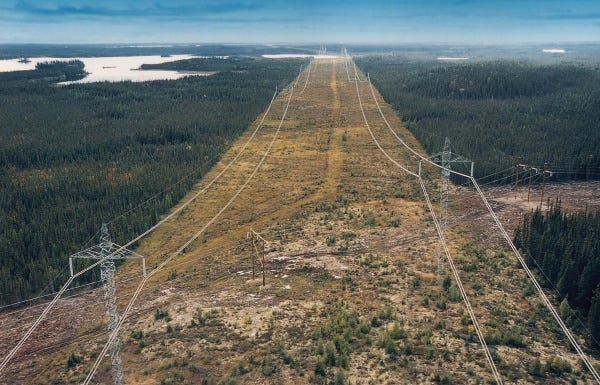
(The picture above is from this article)
A solution should be measured against a worst-case scenario and how it performs in that scenario. In Manitoba, this is winter. Solar does not perform well in winters in Manitoba simply because there are not enough daylight hours. Wind turbine manufacturers report of “some turbines can operate in temperatures down to -30C” and “Cold weather extreme turbines, the electrical components, gearbox and generator are designed to survive, not operate, down to -40ºC”. “The Vestas Low Temperature Option enables wind turbine operation in ambient temperatures as low as -30°C and safe withstanding of an ambient temperature as low as -40°C in pause”. We saw this had a negative effect on the operations of the 4400MW+ of wind turbine capacity in AB during their cold snap in January of 2024. Of course we all know Manitoba regularly experiences these temperatures and not having reliable electricity in such circumstances can literally be a life or death situation.
The short term fix to stop importing electricity and meet current demand with reliable electricity generators will likely be fossil gas plants. We need to think long term and strategically to solve this critical issue. We cannot repeat the same energy transition mistakes that Germany, Denmark and parts of Australia have made as these have proven to be too expensive, too dependent on imports and still burn far too much fossil fuels (and biomass). High energy costs have serious negative consequences. On June 30, 2025, 5.42 million people were employed in German industry, 114,000 fewer than 12 months earlier. In the following six weeks, German corporations announced the elimination of more than 125,000 jobs. Manitoba residential electricity rates are $0.1 per kilowatt-hour, Germany, Denmark and South Australia are over $0.5US dollars per kwh. Residential electricity rates in France are $0.2US dollars per kwh, it is a net electricity exporter, burns very little fossil fuels and over 70% of their electricity is generated by nuclear energy.
I want Manitoba, First Nations communities and the prairie provinces to be a global centre of excellence for clean energy and specifically for nuclear microreactors. I have been in contact with Alpha Tech Research Corp. for over two years now, specifically Dr. Matthew Memmott, Founder and Senior Technical Advisor (see his Google Scholar page here). They are a molten salt microreactor company. Their microreactor will be shipping container size, generate 10megawatts of electricity. They claim they will be able to build 1000 per year at each manufacturing plant! They claim that one reactor will be able to operate at as little as 1megawatt of electricity. Also they will be able to deploy up to 100 at any one site!
Alpha Tech Research Corp have developed salt that is 100% pure. They have addressed corrosion issues with salt and this salt is now a commercial product for them that anyone can purchase. They expect to utilize the Demonstration of Microreactor Experiments (DOME) program at Idaho National Labs (INL) next year. They would have the use of the DOME for about 2 months. INL has asked them to keep their reactor onsite for a year once they are completed with DOME. Dr. Memmott also expects an announcement that they will be included in the “New Reactor Pilot Program“ before the end of this year.
Alpha Tech Research Corp will be opening operations in the USA (they are based out of Utah and Brigham Young University), but they want access to the international market and they know they need to have operations outside of the USA to access the international market. They are very interested in Manitoba and Whiteshell Labs! Very few have heard of them because they are purposely keeping a very low profile. Read about Transatomic Power in this article to understand why.
Alpha Tech Research Corp will also be able to develop advanced medical isotopes with bismuth-213, as they will eventually use thorium. This will allow for targeted alpha therapy for radiation treatment, which will kill only cancer cells and leave healthy cells intact! They have developed a pyroprocessing technology they call CELEX, which allows for nuclear waste to be a valuable resource! Read about CELEX at the bottom of their web page.
Canada and the world need microreactors for Indigenous communities, remote off-grid communities, remote mining operations, island communities, etc. I would like for Manitoba and the prairie provinces to build and export Alpha Tech Research Corp molten salt microreactors through the Port of Churchill and Neestanan to markets all over the world! This would be a game changer for Manitoba and Canadian prairie provinces!