
Manitoba needs electricity generators that operate in all weather conditions!
Climate change can cause weather volatility and unpredictability

This winter has been especially difficult for Manitoba electricity operations. Manitoba typically exports electricity in the summer and imports electricity in the winter, due to almost all of Manitoba’s electricity generators being hydro dams. However, the worst drought in over 100 years occurred in 2025, meaning Manitoba has been almost entirely importing electricity since the end of June 2025 to meet existing electricity demands. Some claim these “once in a century” weather events now seem to happen every five to ten years.
Almost all of the electricity Manitoba imports is from the Midcontinent Independent System Operator (MISO) grid. This grid serves approximately 60 million people from the Manitoba-Minnesota border to the Gulf of Mexico in Louisiana. The North American Electricity Reliability Corporation (NERC) published their most recent Long-Term Reliability Assessment in late January, 2026. The assessment stated the winter reserve margin for Manitoba Hydro for 2030 is expected to be 1.2%, the lowest in the entire report. Reserve margin is recommended to be at least 15% capacity above maximum load. From the post “This map should alarm you” ‘“The Midcontinent Independent System Operator, the 15-state grid that covers much of the American Midwest, faces particularly dire conditions, slipping into code-yellow “elevated risk” next year and code-red “high risk” in 2028. The reason? “Projected resource additions do not keep pace with escalating demand forecasts and announced generator retirements.”’
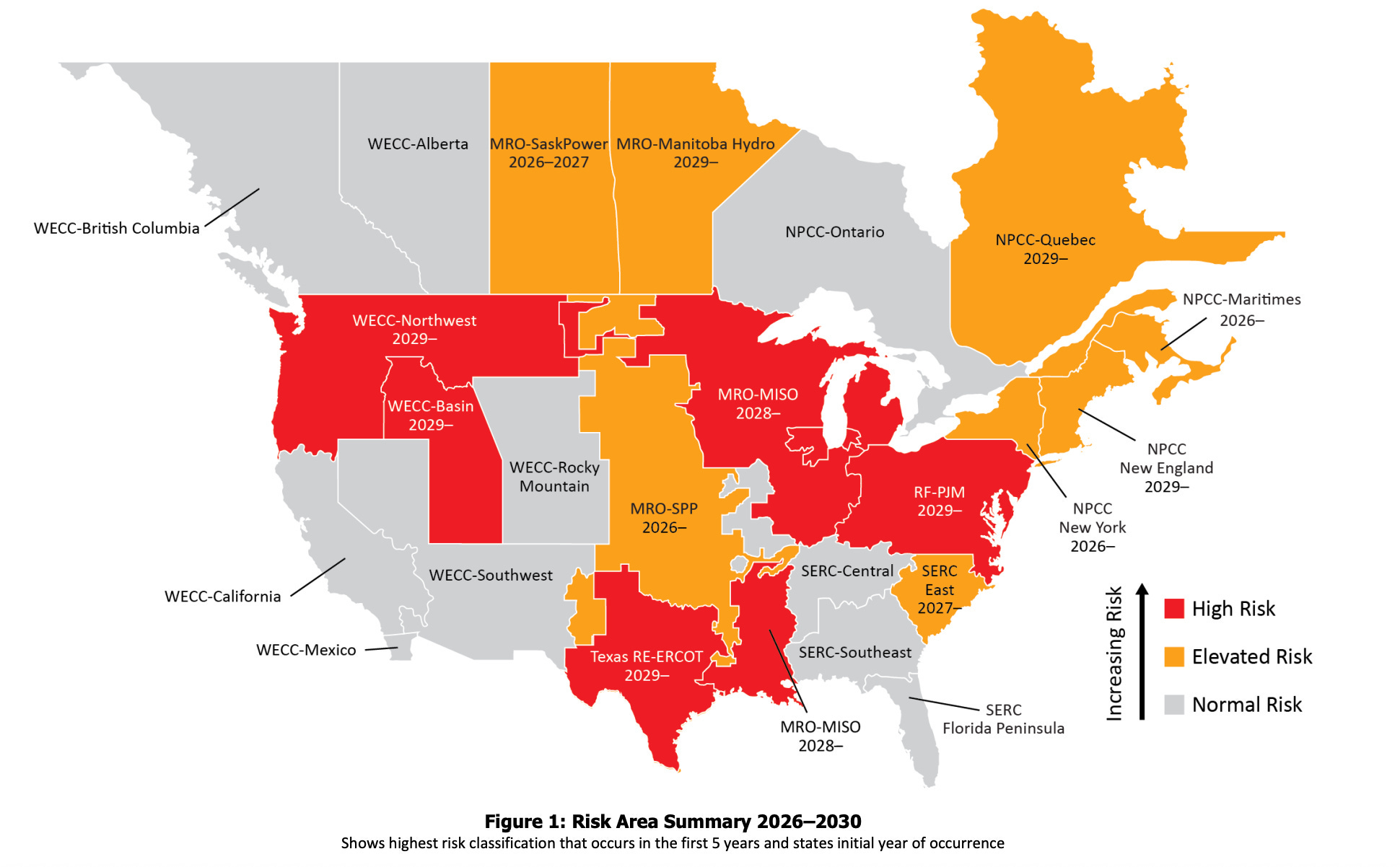
“Things got a little dicey early on January 24th in the Midcontinent Independent System Operator (MISO) territory, as the Regional Transmission Organization (RTO) declared Energy Emergency Alert 2 (EEA2), the step immediately below firm load shedding (EEA3).” Load shedding is controlled rolling blackouts to help electricity supply meet demand when demand is too high. In other words, area A is cut off from electricity for a few hours, next is area B’s turn to be cut off from electricity for a few hours, etc. Would exports to Manitoba have been the first to be cut off from electricity? Fortunately, we did not find out, as it was bitterly cold that day. Manitoba has seen the tragic consequences of being without electricity in bitterly cold conditions this winter at Pimicikamak Cree Nation when their power line was damaged.
During a three or four day period in and around January 24th, 2026, the weather had a negative impact on weather-dependent electricity generators. It is common for there to be low wind speeds during these conditions and this was certainly the case during this time period. We saw wind turbines all over Canada and the USA deliver minimal electricity. Capacity factor is a good indicator of performance, which is average output during a given time period, divided by potential maximum output. There is a great explanation of capacity factor at the end of this Power versus Energy Infographic. For the 12 month period ending January 24th, 2026, nuclear energy in Texas was ~90%. Capacity factors for wind turbines were as low as 25% in Manitoba and Alberta, 12% in SK, 36% in Ontario and New England, 28% in Texas. and 11% in MISO.
Manitoba does not want to import electricity for several reasons, one of which is for geopolitical reasons and the other is Manitoba Hydro’s dependence on imports from the soon-to-be high risk reliability rating of the MISO grid.
For the first quarter that ended in June, 2025, Manitoba Hydro exported 1 terawatt-hour (which is about 1000 gigawatt-hours [GWh]. For perspective 1 gigawatt-hour provides electricity for approximately one million homes) and lost $61 million. In the second quarter, Manitoba Hydro imported 1 TWh and lost $232 million. The third quarter ended in December, 2025 in which 1.3TWh were imported. The third quarterly financial report has not yet been published. Manitoba imported 418GWh in November, 2025, 649GWh in December, 2025 and 497GWh in January, 2026.
Manitoba Hydro needs to stop importing electricity for not only reliability reasons, but also for financial reasons. A major part of the Province of Manitoba’s budget is Manitoba Hydro’s revenues and expenses. At the beginning of the 2025-2026 fiscal year, Manitoba Hydro projected a profit of $214 million, they then revised it at the beginning of January, 2026 to be a loss of $409 million. However, it now seems that it will be at least a $700 million loss. Manitoba Hydro does not have a “weather Nostradamus” on staff and therefore a weather-based budgetary system is a risky financial gamble, as is then also the case for the Province of Manitoba.
Manitoba must embark on a long-term plan to make Manitoba Hydro’s electricity grid reliable, resilient, stable, dependable and secure to maintain current standards of living, allow for its economy to grow, power new and expanding infrastructure such as The Port of Churchill, export electricity to various regions such as Nunavut and completely stop importing electricity from anywhere at all times.
This requires deploying nuclear energy, as has been done in Ontario and New Brunswick and as is desired in Alberta, Saskatchewan and Nova Scotia. The Canadian Ministry of Energy and Natural Resources have offered its formal support to Manitoba if it chooses to deploy nuclear energy.
As can be seen by these charts, nuclear energy is one of the cleanest and safest sources of energy that is available. The Minister of Energy and Natural Resources, and native Manitoban, Hon. Tim Hodgson, has endorsed Prodigy Clean Energy Ltd. as a solution for northern coastal communities, such as the Town of Churchill and the Port of Churchill. ‘“To become a clean energy superpower, we need to deploy affordable, reliable, clean Canadian energy from coast to coast to coast – especially in rural, northern and remote regions, where there can be fewer options for families. That is why our new government is proud to support projects like Prodigy’s Transportable Nuclear Power Plant. By advancing promising Canadian technologies such as Prodigy’s, we are supporting economic growth in the North while strengthening Canada’s energy security”’.
Manitoba has the Atomic Energy of Canada Ltd.’s Whiteshell Laboratories within its borders. It has been in operations since the early 1960’s and has a long and impressive record of scientific and engineering achievements related to nuclear energy. It is currently being decommissioned and has 4,000 hectares available for nuclear reactor research and development, as well as commercial operations. Manitoba’s hydro dams are 1,000 kilometres away and far north from where most of the electricity is consumed, Winnipeg and surrounding area. This means $7 billion dollar upgrades on transmission lines are to be expected, as was announced in July, 2025. Whiteshell Labs is 12 kilometres west of Pinawa and 100 kilometres east of Winnipeg. Transmission lines would certainly need to be upgraded as part of the cost of deploying nuclear energy, but Manitoba needs to move forward. Whiteshell Labs is also in a favorable location to export electricity to Ontario and the MISO grid.
Manitoba needs major changes and upgrades to its electricity grid and infrastructure. The sooner these commence, the sooner Manitoba will have reliable, resilient, stable, dependable, clean and predictable electricity.
Wake up to wind droughts and get wind and solar off the grid.
Some capacity ain’t capacity when it is wind and solar on a windless night.
As the old saying goes, oils ain’t oils!
https://youtu.be/c7TUiMCeils
SIMPLIFY THE GRID!
https://rafechampion.substack.com/p/its-time-to-simplify-the-grid